







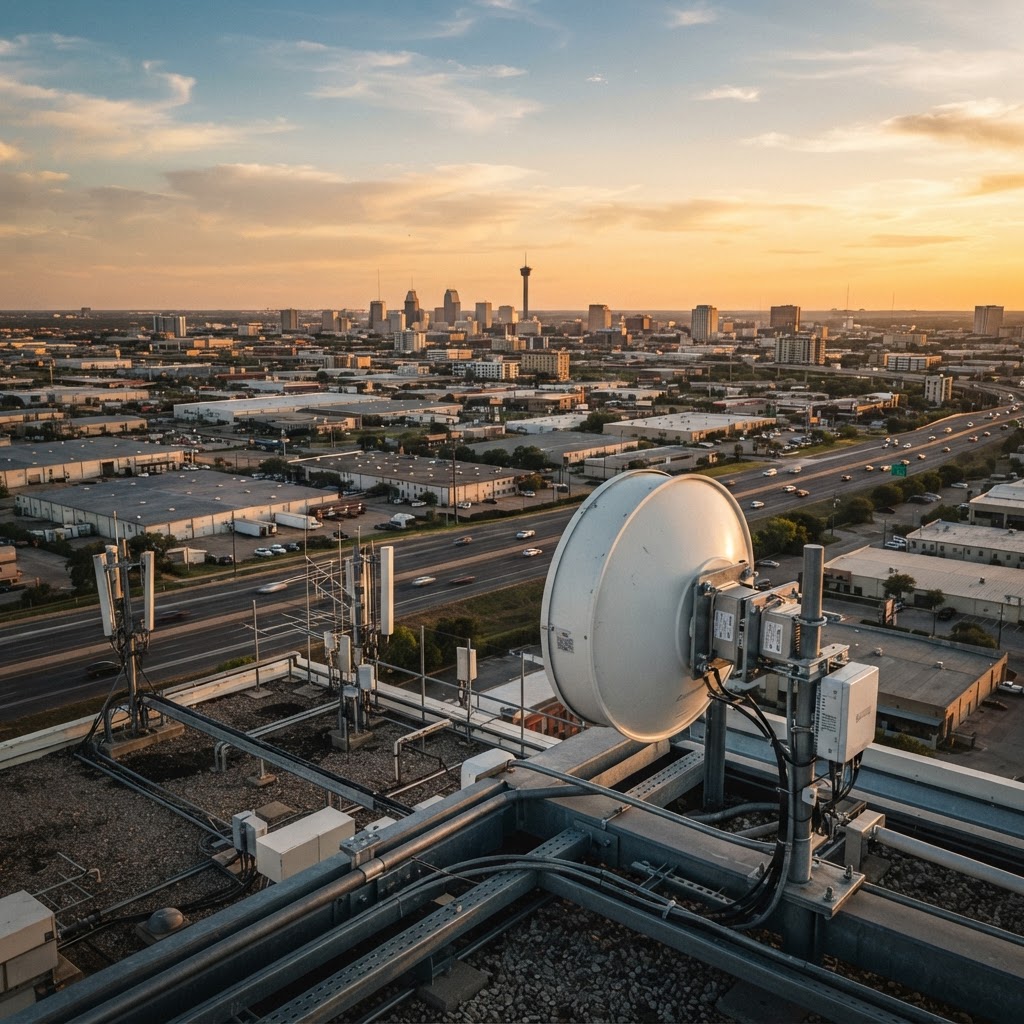
The fiber is right there. Maybe it's across the highway. Down the street. Inside another building. At a nearby tower. Or terminating several miles from your facility. But the answer from the carrier is still: "Fiber isn't available at your address."
That's one of the most frustrating situations in enterprise telecommunications. The capacity exists. The network exists. The problem is getting from where the fiber stops to where your business begins. The traditional solution is fiber construction. But it isn't always the only solution. For the right San Antonio location, high-capacity point-to-point wireless can potentially bridge the gap between existing fiber infrastructure and the building that needs connectivity. Instead of trenching fiber across the entire route, part of the connection can travel through the air.
The Problem Isn't Always Fiber Availability
When businesses hear that fiber isn't available, they often assume there is no fiber anywhere nearby. That isn't necessarily true. Carrier fiber networks run throughout major metropolitan areas like San Antonio. But having fiber in the area is very different from having fiber physically connected to your building.
There may be significant infrastructure separating your facility from the nearest practical fiber access point. That can include:
- Streets
- Highways
- Parking lots
- Railroads
- Neighboring properties
- Utility easements
- Drainage areas
- Existing underground utilities
- Rights-of-way
- Industrial property
- Large undeveloped areas
Getting fiber across those obstacles can turn the final portion of a network connection into a major construction project.
What Is the Fiber Last-Mile Problem?
In telecommunications, the "last mile" generally describes the final portion of the network connecting the provider's infrastructure to the customer. It doesn't necessarily mean exactly one mile. It could be 500 feet. A few blocks. One mile. Several miles. The important point is that the high-capacity network exists somewhere nearby, but it does not physically reach the destination.
This is where project economics can change dramatically. A building may be relatively close to fiber while still requiring significant construction to reach it.
Why Is Extending Fiber Expensive?
Installing fiber isn't simply a matter of buying a spool of cable. Depending on the route, a fiber extension may involve:
- Engineering
- Utility locating
- Permitting
- Right-of-way access
- Easements
- Trenching
- Directional boring
- Conduit
- Handholes
- Road crossings
- Railroad coordination
- Traffic control
- Utility coordination
- Fiber pulling
- Splicing
- Testing
- Restoration
Every project is different. Some fiber extensions are straightforward. Others can become complex civil construction projects. This is why a carrier may tell a business that service is technically possible — but require substantial construction cost or a long installation timeline.
Fiber can be nearby without being available at your building.
What If You Could Go Over the Obstacle Instead?
This is where point-to-point wireless becomes interesting. Instead of physically constructing fiber through or underneath every obstacle between the network and the customer, a dedicated radio path can potentially connect the two locations through the air. The basic architecture is:
Point-to-point wireless can bridge the distance between existing fiber infrastructure and a commercial facility.
The fiber still does the heavy lifting across the larger telecommunications network. Wireless solves the final connection problem.
Fiber Stops Before Your Building?
The network doesn't necessarily have to stop there. NetWest can evaluate whether point-to-point wireless can bridge the gap between existing fiber infrastructure and your facility.
This Isn't Wi-Fi
When people hear "wireless internet," they often think about Wi-Fi. That's not what we're describing. Enterprise point-to-point wireless uses highly directional antennas designed to communicate between specific locations. For demanding applications, NetWest can also deploy licensed microwave systems using coordinated spectrum. Depending on the network design, point-to-point systems can provide:
- High bandwidth
- Low latency
- Dedicated connectivity
- Long-distance transport
- Private network connectivity
- Enterprise routing
- Fiber extension
- Network redundancy
This technology is used throughout the telecommunications industry.
A Simple San Antonio Example
Imagine a distribution company opens a new facility in San Antonio. The company needs high-capacity connectivity for warehouse systems, inventory, shipping, VoIP, security cameras, cloud applications, employee connectivity and remote access. Fiber exists several miles away. But extending it directly to the facility would require significant construction.
Suppose a suitable fiber-connected building or network location has line-of-sight to the distribution facility. The network could potentially be designed like this:
A path to the fiber network without underground fiber construction across the entire distance.
The business now has a path to the fiber network without requiring underground fiber construction across the entire distance.
When Does Wireless Fiber Extension Make Sense?
Wireless isn't automatically the answer. The location has to work. Good candidates may include:
Warehouses
Large commercial buildings often have good rooftop mounting opportunities.
Distribution Centers
Located in industrial areas where carrier fiber may not extend directly to every property.
Manufacturing Facilities
Industrial locations may require significant bandwidth while being separated from carrier infrastructure.
Commercial Buildings
One fiber-connected property may provide a network path to another nearby building.
Construction Projects
Wireless can provide connectivity while permanent infrastructure is still being developed.
Remote Industrial Facilities
Locations outside dense commercial corridors may benefit from long-distance wireless transport.
Multi-Building Campuses
Wireless can extend connectivity between buildings without trenching fiber throughout the property.
Data Center & Technology Facilities
Wireless can provide alternate transport paths subject to bandwidth and availability requirements.
What Determines Whether a Wireless Path Will Work?
The first major requirement is generally a suitable radio path. NetWest evaluates factors including:
- Latitude and longitude
- Ground elevation
- Building height
- Rooftop height
- Tower height
- Distance
- Terrain
- Trees
- Buildings
- Other obstructions
- Fresnel zone clearance
- Frequency
- Required bandwidth
- Antenna size
- Reliability objectives
A location that appears impossible from ground level may sometimes become possible from a rooftop or tower. Other locations may require an intermediate relay point. Some locations won't be suitable for wireless at all. That's why the process begins with engineering.
What Is a Wireless Path Study?
A preliminary wireless path study evaluates whether two locations may be capable of communicating using point-to-point radio technology. NetWest can begin with something as simple as: The service address.
From there, our team can investigate nearby NetWest infrastructure, potential network locations, building elevations, tower opportunities, approximate path distance, terrain, potential obstructions, available fiber and bandwidth requirements. If the path appears viable, additional engineering and a site survey may be appropriate.
Can Wireless Really Deliver Gigabit Connectivity?
Modern point-to-point wireless technology is capable of substantial bandwidth. Actual capacity depends on the specific radio, frequency, channel configuration, distance, spectrum availability, signal conditions, antenna system and network architecture. NetWest has deployed gigabit-class wireless connectivity for enterprise applications. Wireless should not automatically be viewed as a low-speed substitute for fiber. In the right architecture, it can be part of a high-capacity enterprise network.
How Fast Can Wireless Be Installed Compared With Fiber?
There is no universal installation timeline. Every project is different. But wireless can eliminate some of the civil construction required by traditional fiber extensions. A fiber project may require coordination involving underground utilities, permitting, construction, road crossings, easements, boring and restoration. A wireless project instead focuses heavily on path engineering, site access, rooftop or tower access, mounting, equipment installation, cabling, network configuration and testing. When suitable infrastructure and line-of-sight already exist, wireless can potentially shorten the path between project approval and network activation.
Wireless Doesn't Have to Replace Fiber
This is important. NetWest is not suggesting that businesses abandon fiber. Quite the opposite. Fiber and wireless complement one another. Think about the network like this:
Fiber
High-capacity backbone
Wireless
Flexible extension
Fiber carries enormous amounts of data across telecommunications networks. Wireless can take that capacity beyond the physical endpoint of the fiber. This creates an architecture that uses the strengths of both technologies.
Instead of digging the entire distance, sometimes we can bridge it through the air.
Another Benefit: The Wireless Link Can Become Your Diverse Path
Suppose a company eventually gets direct fiber installed at its facility. Does that make the wireless connection obsolete? Not necessarily. The architecture could evolve.
Phase 1 — Wireless Extension
Phase 2 — Diverse Backup
A wireless fiber extension can potentially become a diverse backup path after direct fiber reaches the facility.
The wireless connection that originally solved the fiber-extension problem can potentially become part of the company's network redundancy strategy. That can make the initial wireless infrastructure even more valuable.
The Cost Question
Businesses naturally want to know: Is wireless cheaper than extending fiber? Sometimes. But not always. The economics depend on the specific project.
Wireless costs can involve:
- Radios
- Antennas
- Mounting
- Rooftop or tower access
- Cabling
- Network equipment
- Installation
- Engineering
- Spectrum coordination where applicable
Fiber costs can involve:
- Construction
- Conduit
- Trenching
- Boring
- Permitting
- Fiber
- Splicing
- Restoration
The correct comparison isn't "Is wireless cheap?" It's "What is the most practical way to get the required connectivity into this building?" Sometimes that's fiber. Sometimes it's wireless. Sometimes it's a combination.
Don't Automatically Accept "Fiber Not Available"
If a carrier availability search says fiber isn't available at your San Antonio address, that doesn't necessarily mean high-capacity connectivity is impossible. It may simply mean: That carrier's fiber doesn't currently reach your building.
There may be another fiber provider. There may be another nearby network location. There may be a tower. There may be a rooftop. There may be a wireless path. There may be another way to design the network. That's where custom network engineering becomes valuable.
NetWest Is Live in San Antonio
We've expanded our enterprise network capabilities into San Antonio with new high-capacity telecommunications infrastructure — combining carrier connectivity, rooftop infrastructure and high-capacity point-to-point wireless technology to deliver real enterprise network service.
Amazon Distribution Facility
High-capacity connectivity supporting a new distribution operation.
Toyota GFX Building
Enterprise connectivity supporting a major commercial facility.
"Taking connectivity from where it exists to where it needs to go."
The same philosophy NetWest has used for decades — now building in San Antonio.
Built on Nearly 30 Years of Network Experience
NetWest Online has been building telecommunications networks since 1996. Our roots are in West Texas. In West Texas, the answer to "Where's the fiber?" isn't always "Right outside the building." Connecting businesses, industrial facilities and remote operations requires understanding multiple technologies.
Over the years NetWest has built expertise involving fiber, point-to-point wireless, licensed microwave, towers, rooftops, structured cabling, network routing, enterprise internet, infrastructure construction and network troubleshooting. We're now bringing that experience to enterprise projects in San Antonio.
Fiber Nearby? Let NetWest Look at the Last Mile.
If your San Antonio business has been told "Fiber isn't available," "Construction is required," "The build-out will be expensive," "The installation will take too long," or "We can get fiber close, but not to your building" — send NetWest the address. We can evaluate whether another network architecture may be possible. You don't need to determine whether you need fiber, microwave or point-to-point wireless. That's our job.