







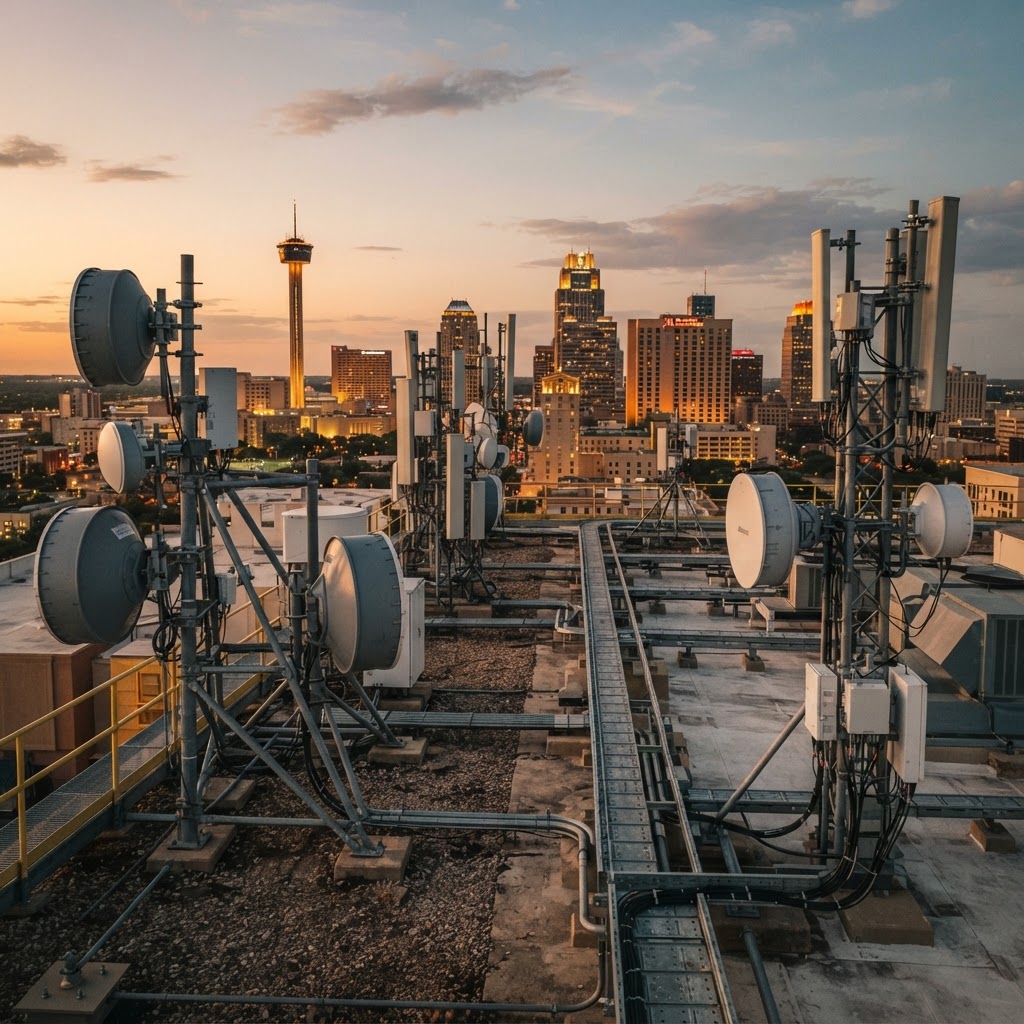
Fiber is fast. Wireless is flexible. So which one should a San Antonio business choose? The answer isn't as simple as declaring one technology better than the other.
For enterprise networks, the better question is: Which technology makes the most sense for this location, this application and this network?
Sometimes that's fiber. Sometimes it's point-to-point wireless. And increasingly, the best enterprise networks use both. NetWest Online designs telecommunications infrastructure around the actual requirements of the facility rather than forcing every location into the same type of connection. Here's how the technologies compare.
What Is Fiber Internet?
Fiber-optic networks transmit data using light traveling through strands of glass or optical fiber. Fiber can provide enormous capacity with extremely low latency and is the foundation of much of the world's telecommunications infrastructure. NetWest uses fiber extensively throughout our own network and enterprise internet in San Antonio deployments.
For a business located in a building where high-capacity fiber already exists, fiber may be the obvious primary connection. The challenge begins when fiber isn't already where you need it.
What Is Point-to-Point Wireless?
Point-to-point wireless creates a dedicated radio connection between two locations. Directional antennas are installed at each end of the connection and aligned with one another. Instead of installing underground cable across the entire distance between the locations, data travels through the air.
Modern carrier-grade point-to-point wireless systems can provide high bandwidth with very low latency. Depending on the application, frequency, distance, equipment and available spectrum, these systems can support demanding enterprise networks.
Fiber vs. Wireless: The Basic Comparison
| Factor | Fiber | Point-to-Point Wireless |
|---|---|---|
| Bandwidth | Extremely high capacity | High to very high capacity depending on system and path |
| Latency | Extremely low | Extremely low on properly engineered links |
| Construction | May require trenching, conduit, permits and right-of-way | Primarily requires suitable mounting locations and line-of-sight |
| Deployment Time | Can range from simple installation to lengthy construction | Can often be deployed faster when infrastructure and line-of-sight are available |
| Physical Route | Underground or aerial cable | Through the air between locations |
| Distance | Excellent for virtually any distance with proper network infrastructure | Excellent for appropriate line-of-sight paths |
| Redundancy | Excellent when physically diverse routes exist | Excellent for creating a physically different path from underground fiber |
| Interference | Not affected by radio interference | Must be professionally engineered; licensed spectrum can reduce interference concerns |
| Construction Cost | Can become expensive when significant construction is required | Can avoid major trenching costs in appropriate situations |
| Scalability | Exceptional | Depends on radio technology, spectrum and path design |
When Fiber Makes the Most Sense
Fiber is often the best choice when high-capacity infrastructure already reaches the building. Examples include:
- Office towers
- Data centers
- Large commercial buildings
- Carrier hotels
- Major industrial campuses
- Facilities located along existing fiber routes
If the fiber is already installed and appropriate capacity is available, there may be little reason to replace it with wireless. NetWest's philosophy is simple:
Use the technology that makes sense.
The objective isn't to sell wireless instead of fiber. The objective is to build the right network.
The question isn't whether fiber or wireless is better. The question is which network architecture solves the problem.
When Wireless Makes More Sense
Point-to-point wireless becomes especially attractive when geography or construction makes fiber difficult. Consider a facility located one mile from available fiber. The fiber connection may technically be nearby. But getting it into the building could require:
- Engineering
- Permits
- Underground construction
- Trenching
- Boring
- Conduit
- Easements
- Street crossings
- Railroad crossings
- Utility coordination
- Construction crews
That one mile can turn into a significant construction project. Wireless may provide another option. If NetWest can establish a suitable line-of-sight path between the facility and network infrastructure, the final connection may be delivered through the air rather than by constructing underground fiber for the entire distance.
Fiber Without Fiber to the Building
This is one of the most useful applications of point-to-point wireless. Suppose high-capacity fiber exists at Building A. Building B needs the connectivity but is several miles away. Instead of extending physical fiber the entire distance, the architecture can look like this:
Point-to-point wireless can extend high-capacity connectivity beyond the physical endpoint of a fiber network.
The customer can receive high-capacity connectivity even though the final portion of the network doesn't travel through underground fiber. This is sometimes described as a wireless fiber extension.
Building-to-Building Connectivity
Another strong application is connecting buildings owned or operated by the same organization. Imagine a San Antonio company with Warehouse A, Warehouse B, a Corporate Office and a Maintenance Facility. The buildings may be separated by parking lots, roads or neighboring properties. Running new fiber between every location may require significant construction.
Point-to-point wireless can potentially create private high-capacity links between the facilities. Applications can include:
- Shared internet access
- Private network connectivity
- VoIP
- Security cameras
- Access control
- File servers
- Cloud applications
- Inventory systems
- Building management systems
For campuses, industrial facilities and distribution operations, wireless can become part of the organization's private network infrastructure.
The Biggest Advantage of Wireless May Be Something Other Than Speed
Businesses often compare telecommunications services based primarily on bandwidth. 100 Mbps. 500 Mbps. 1 Gbps. 10 Gbps. Bandwidth matters. But one of wireless's most important advantages isn't speed. It's route diversity.
Fiber has to physically travel somewhere. Wireless follows an entirely different path. Through the air. That distinction becomes extremely important when designing backup connectivity.
Fiber + Wireless: A Powerful Redundancy Strategy
Consider this architecture: a primary carrier fiber connection and a secondary NetWest point-to-point wireless connection. If properly designed, the two network connections can use fundamentally different physical paths. One travels underground. One travels through the air. This reduces the risk that a single construction accident or conduit failure will disable both connections. Learn more about physical path diversity.
Primary — Underground
Backup — Through the Air
Combining underground fiber with wireless connectivity can create physical network path diversity.