







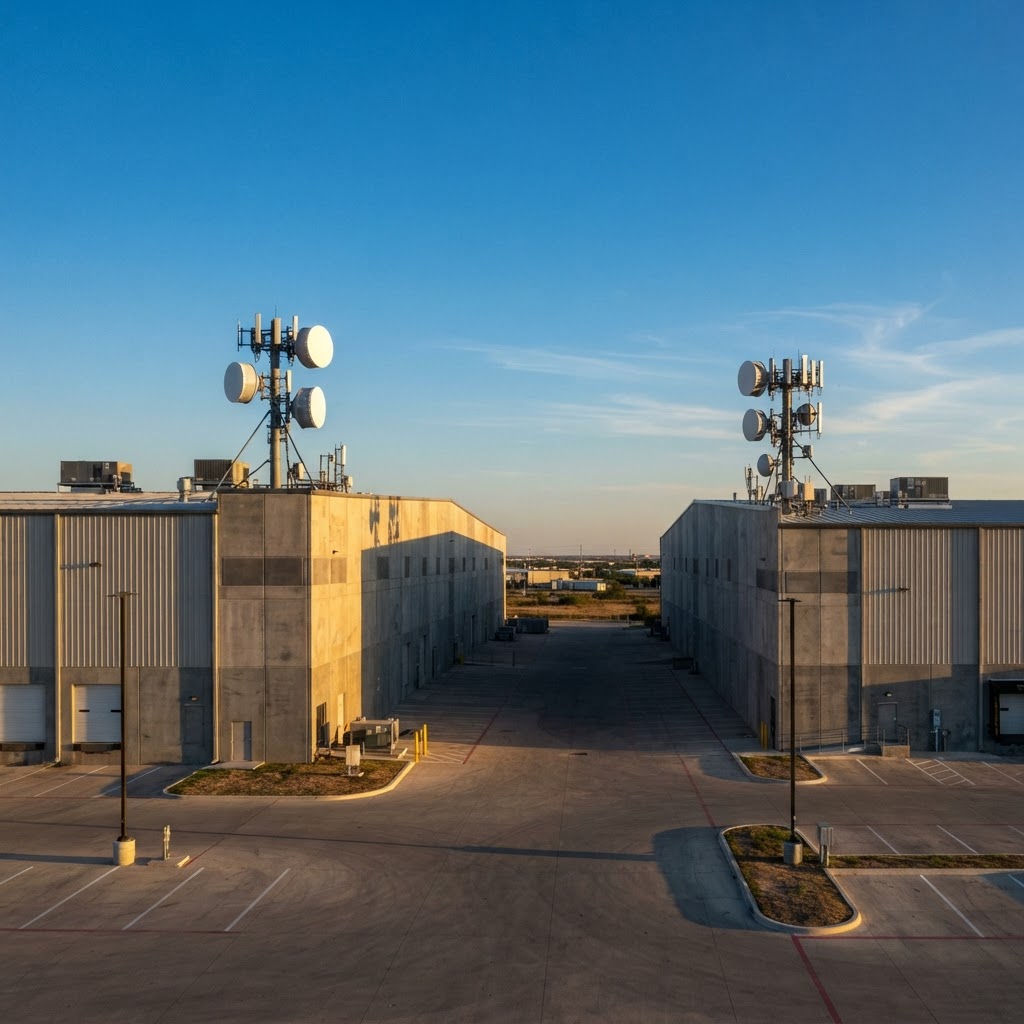
Your internet connection is already in Building A. But your operation isn't. There's also Building B — the warehouse across the property, the maintenance building down the road, the office on the other side of the parking lot, the distribution facility a few miles away, or another company location somewhere across San Antonio.
Now you have another problem: How do you connect the buildings?
The traditional answer is usually fiber. And when fiber is already available between the locations, that may be exactly the right solution. But when fiber isn't there, connecting two buildings can become a construction project involving trenching, conduit, permits, easements and significant expense.
There may be another option. High-capacity point-to-point wireless can create a dedicated network connection between buildings without installing underground fiber across the entire route.
Point-to-point wireless creates a dedicated network path between facilities.
What Is Building-to-Building Wireless?
Building-to-building wireless uses directional radio systems to establish a dedicated connection between two locations. Think of it as an invisible network cable running through the air.
Instead of routing traffic through underground fiber, the network can use a point-to-point wireless link between the two buildings. Depending on the design, that link may carry:
- Internet traffic
- Private network traffic
- Voice
- Video
- Security cameras
- Cloud applications
- File transfers
- VLANs
- Operational systems
- Building management traffic
The exact network architecture depends on the organization's requirements.
This Is Not Ordinary Wi-Fi
Building-to-building wireless should not be confused with trying to make an indoor Wi-Fi access point reach another building. Enterprise point-to-point systems use directional antennas designed to communicate between specific locations. For demanding applications, NetWest can also deploy licensed microwave technology using coordinated radio spectrum.
These systems are designed for telecommunications transport. The result can be a high-capacity network connection between facilities without running a physical cable across the entire distance.
Think of point-to-point wireless as an invisible network cable running through the air.
Example: Office + Warehouse
Imagine a San Antonio company has its primary office in Building A. The company's internet connection, firewall, servers and network infrastructure are located there. The company leases a warehouse nearby. The warehouse needs internet, VoIP, security cameras, inventory systems, Wi-Fi, access control and corporate network access.
One option is to order an entirely separate internet connection at the warehouse. Another option may be to extend the company's existing network.
The warehouse can potentially become part of the organization's larger network architecture.
Example: Industrial Campus
Consider an industrial property containing a main office, warehouse, maintenance shop, operations building, security gate and storage facility. Running new underground fiber between every structure may require substantial construction. A properly designed wireless network could potentially create links between these locations.
Wireless can be used to create private multi-building network infrastructure.
Wireless can be used to create private multi-building network infrastructure.
Why Connect Buildings Instead of Buying Internet at Every Building?
There is nothing inherently wrong with purchasing separate internet circuits. In some situations, that is the correct architecture. But organizations should consider whether they actually need independent internet service at every structure — or whether they need the buildings connected. Those are different problems.
If Building A already has substantial connectivity and Building B simply needs access to company resources, extending the private network may be worth evaluating. Potential benefits can include:
- Centralized network management
- Shared internet infrastructure
- Shared firewall architecture
- Centralized security policies
- Private communication between facilities
- Shared servers and applications
- Centralized monitoring
- Simplified network administration
The best architecture depends on security, redundancy, bandwidth and operational requirements.
Do you need another internet circuit — or do you need the buildings connected?
Avoid Trenching Across the Property
This is one of the most obvious advantages of point-to-point wireless. Imagine two warehouses separated by a large parking lot. Running fiber between them could require cutting pavement, trenching, conduit, boring, utility locating, construction crews and surface restoration.
Wireless may be able to cross that same parking lot without disturbing the pavement. The antennas are installed at suitable elevated locations and communicate through the air. That can make wireless especially useful across parking lots, industrial yards, roads, large commercial properties, difficult terrain and areas with significant existing underground utilities.
Dig Under It or Go Over It?
Traditional Fiber Extension
Wireless
Where line-of-sight exists, point-to-point wireless may provide another way to connect facilities.
Need to Connect Two Buildings?
Before trenching fiber across the property, let NetWest evaluate whether a wireless path is possible. Send us both addresses.
Connect Buildings Across a Road
Sometimes the buildings aren't on the same property. Perhaps a company expands into a building across the street. The distance may only be a few hundred feet. But the road changes everything. Installing fiber may require permits, right-of-way access or boring beneath the roadway.
If suitable line-of-sight exists, wireless may be able to bridge the road through the air. No network design should assume this is possible without engineering and appropriate property and access permissions. But it is an option worth evaluating before automatically beginning underground construction.
Connect Facilities Miles Apart
Building-to-building wireless isn't limited to buildings sitting next to each other. Depending on frequency, terrain, antenna height, building height, tower availability, radio technology, required bandwidth, spectrum and path clearance, point-to-point wireless systems can operate across significant distances.
A company may potentially connect a corporate office, warehouse, distribution facility and remote operations site. Each project must be engineered individually.
What If the Buildings Don't Have Line-of-Sight?
Direct line-of-sight is important for many high-capacity microwave systems. But lack of a direct path doesn't always end the project. A network may sometimes use an intermediate location — a relay positioned on a tower, a tall commercial building, an existing telecommunications site, or another company facility.
Whether this is practical depends on available infrastructure, access and network economics. Some paths simply will not be good candidates for wireless. NetWest evaluates the location before recommending a solution.
Rooftops Can Become Network Assets
Commercial rooftops are often overlooked. But elevation is extremely valuable in wireless telecommunications. A building with good height, clear views, rooftop access, power and network connectivity can become an important point in a private wireless network. One rooftop may be capable of reaching multiple company facilities — creating interesting possibilities for organizations operating multiple locations within the same geographic area.
Hub-and-Spoke Wireless Networks
Not every wireless network has to connect only two buildings. A central facility can potentially serve as a hub for multiple locations. The central location can provide network connectivity to several facilities. This architecture is often called a hub-and-spoke design.
Whether it is appropriate depends on bandwidth, distance, network topology, redundancy requirements, spectrum and available mounting locations.
Private Network vs. Internet Connection
This distinction is important. Point-to-point wireless does not necessarily have to provide internet service. It can simply transport network traffic between locations. The important concept is that wireless can act as network transport, not merely internet access. The actual addressing and architecture should be designed by the organization's network engineers.
Applications for Building-to-Building Wireless
Warehouses
Connect warehouse management systems, employee Wi-Fi, cameras, phones and inventory systems.
Distribution Centers
Extend enterprise connectivity to logistics and shipping operations.
Manufacturing
Connect production, office and support buildings.
Commercial Campuses
Create private network links between multiple buildings.
Automotive Facilities
Connect offices, service areas, storage facilities and support buildings.
Construction
Extend network connectivity across large project sites.
Security Networks
Transport high-bandwidth surveillance video between locations.
Industrial Facilities
Connect operations buildings, maintenance facilities and remote structures.
Data Center Support Facilities
Create additional network paths between appropriate supporting facilities.
Schools & Institutional Campuses
Connect buildings where new underground construction may be difficult.
Security Camera Networks
Video surveillance is an especially interesting application. Imagine a remote building or property has 20 security cameras. Instead of purchasing independent internet service and sending every camera stream through the public internet, a private wireless connection may be able to transport the camera traffic directly back to the main facility. The appropriate architecture depends on bandwidth, security requirements and network design.
Camera traffic can be transported directly back to the main facility over a private link.
How Much Bandwidth Can Building-to-Building Wireless Provide?
There is no single answer. Available capacity depends on factors including radio platform, frequency, channel width, spectrum availability, distance, signal strength, antenna configuration and network architecture. Modern point-to-point wireless can support high-capacity enterprise applications. NetWest has experience deploying gigabit-class wireless connections.
The network should be designed according to the required application rather than simply installing a radio and hoping it is fast enough.
Latency
Point-to-point microwave can provide very low latency. This matters for applications such as VoIP, cloud applications, interactive systems, video, remote desktop, VPNs and enterprise applications. The total end-to-end latency of a network depends on far more than the wireless link itself, but properly engineered microwave transport can be extremely fast.
Licensed Microwave for Critical Links
For more demanding applications, NetWest can deploy licensed microwave. Licensed microwave uses coordinated spectrum and is widely used throughout the telecommunications industry. Potential advantages include reduced interference concerns, high capacity, long-distance capability, predictable network engineering, professional frequency coordination and carrier-grade applications.
Licensed microwave can be especially appropriate when a wireless link is a critical part of the organization's network infrastructure.
What Happens If One Building Loses Power?
Wireless network design must account for power just like fiber network equipment does. A point-to-point radio requires power. So do routers, switches, firewalls, fiber equipment, servers and access points. For critical applications, network infrastructure may need UPS systems, generator support, monitored power, appropriate grounding and surge protection. A redundant telecommunications network isn't truly resilient if the supporting power infrastructure is ignored.
Can Wireless Be Redundant?
Yes. Wireless itself can be incorporated into redundant network architectures. For example, fiber may serve as the primary path between two buildings while a wireless link serves as the backup. Or two independent wireless paths may be engineered through different infrastructure where appropriate. The architecture depends on how important the connection is to the business.
Fiber + Wireless Campus Networks
For larger operations, the best solution may combine technologies. A fiber backbone can serve the main facility, with wireless extending the private network to outlying buildings. There is no requirement that every network link use the same medium. Good network engineering uses the technology that best fits each segment.
Should You Use Fiber or Wireless Between Buildings?
Ask these questions: Does fiber already exist between the buildings? Would new underground construction be required? How far apart are the buildings? Is there line-of-sight? What bandwidth is required? How critical is the connection? Is network redundancy required? Is rooftop access available? Are towers available? Are the buildings owned or leased? How quickly is connectivity needed? What is the long-term plan for the facilities?
There isn't a universal answer. Learn more in our comparison of point-to-point wireless vs. fiber.
Wireless Can Solve the Last-Mile Problem Too
Building-to-building technology can also be used to extend fiber. Suppose Building A has fiber and Building B does not. Instead of constructing fiber between them, a wireless link can make Building A the network handoff point for Building B.
NetWest Is Live in San Antonio
We've expanded our enterprise network capabilities into San Antonio with new high-capacity telecommunications infrastructure — combining carrier connectivity, rooftop infrastructure and high-capacity point-to-point wireless technology to deliver real enterprise network service.
Amazon Distribution Facility
High-capacity connectivity supporting a new distribution operation.
Toyota GFX Building
Enterprise connectivity supporting a major commercial facility.
"Taking connectivity from where it exists to where it needs to go."
The same philosophy NetWest has used for decades — now building in San Antonio.
Built by People Who Actually Build Networks
NetWest Online has been building telecommunications networks since 1996. Our capabilities extend beyond selling internet circuits. NetWest works with fiber, point-to-point wireless, licensed microwave, towers, rooftops, structured cabling, enterprise routing, network infrastructure, outside plant, network construction and enterprise backup.
That matters when connecting multiple buildings because the solution often crosses several disciplines. A radio alone isn't the network. The network includes everything from the antenna on the roof to the cable entering the building to the router delivering traffic to the customer's infrastructure.
Have Multiple Buildings in San Antonio?
Send NetWest the addresses. We'll evaluate distance between locations, approximate elevations, potential line-of-sight, rooftop opportunities, nearby towers, fiber availability, bandwidth requirements and possible network architectures.
You don't have to know whether you need fiber, wireless or both. Tell us what buildings need to communicate. We'll look for the path.
Before trenching between buildings, check whether you can go over the obstacle instead.