






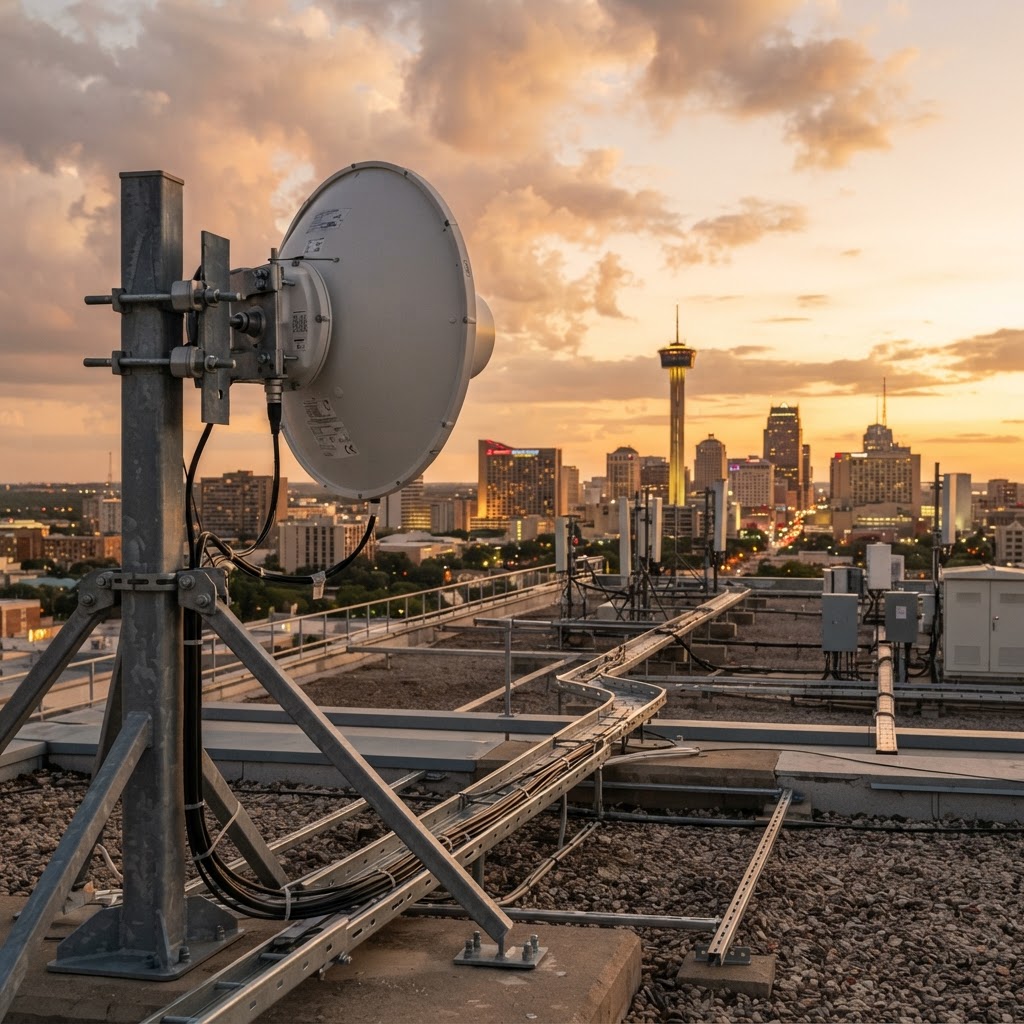
Licensed Microwave Internet & Network Links in San Antonio
Carrier-grade point-to-point wireless for enterprise backup, fiber extension, private networks and difficult locations.
Engineered. Coordinated. Built by a company that has operated wireless networks for nearly thirty years.
Not all wireless networks are the same.
There is a major difference between Wi-Fi, cellular, unlicensed point-to-point wireless, and licensed microwave.
For businesses that require serious bandwidth, predictable performance, long-distance connectivity or physically diverse network paths, licensed microwave can be an important enterprise telecommunications tool.
NetWest Online has decades of experience designing and operating point-to-point wireless networks, including licensed microwave systems used for demanding commercial and infrastructure applications.
The key is knowing when the technology makes sense.
What Is Licensed Microwave?
Licensed microwave is a point-to-point wireless communication system that operates in radio spectrum coordinated for specific network links.
Directional antennas are installed at two locations and aligned with one another. The link can transport data between those locations at high speed and with very low latency.
Unlike ordinary Wi-Fi, licensed microwave is designed for dedicated telecommunications transport.
Licensed microwave creates a dedicated point-to-point network path between two engineered locations.
What Does "Licensed" Actually Mean?
Radio spectrum is regulated.
Some frequencies can be used without obtaining an individual license, provided the equipment follows applicable technical rules. Wi-Fi is a familiar example of unlicensed spectrum.
Licensed microwave works differently.
A proposed link is engineered around specific locations, frequencies and technical parameters. Frequency coordination helps determine whether the proposed radio path can operate without causing unacceptable interference to existing licensed systems.
The licensing process provides a higher level of spectrum coordination than ordinary unlicensed wireless. That can be valuable for network links carrying important enterprise traffic.
Licensed Microwave vs. Wi-Fi
This distinction matters. They serve completely different purposes — Wi-Fi is not inferior, it is simply built for a different job.
| Factor | Wi-Fi | Licensed Microwave |
|---|---|---|
| Typical Purpose | Local wireless access | Dedicated point-to-point network transport |
| Coverage | Local area | Potentially significant distance depending on engineering |
| Antennas | Often broad coverage | Highly directional point-to-point antennas |
| Spectrum | Shared unlicensed spectrum | Coordinated licensed spectrum |
| Interference Environment | Potentially crowded | Engineered and coordinated for specific paths |
| Applications | Phones, laptops, tablets, local devices | Enterprise internet, backhaul, private networks, fiber extension, redundancy |
| Engineering | Often relatively simple | Professional path engineering required |
Licensed Microwave vs. Unlicensed Point-to-Point Wireless
Unlicensed point-to-point wireless can be extremely useful. NetWest uses different wireless technologies depending on the project.
For many short-distance or less critical applications, an unlicensed link may be completely appropriate. Licensed microwave becomes particularly attractive when the network requires more predictable spectrum conditions or the link is critical to the organization's operations.
The choice depends on:
Good engineering means selecting the right tool rather than automatically choosing one frequency band for every project.
Why Businesses Use Licensed Microwave
There are several common reasons.
1Fiber Backup
A company may already have excellent fiber internet. But if the fiber is cut, the business still needs connectivity. Licensed microwave can potentially provide a second network path that does not follow the same underground route — creating the possibility of true physical path diversity.
This creates the possibility of true physical path diversity.
2Fiber Extension
High-capacity fiber may exist at one location but not at the customer building. Licensed microwave can potentially bridge the distance.
Licensed microwave can bridge the distance between existing fiber and a customer building.
3Building-to-Building Networks
A company may want to connect an office, warehouse, manufacturing facility, maintenance building or distribution center. Licensed microwave can transport private network traffic between facilities.
4Industrial Connectivity
Industrial facilities may be located in areas where fiber construction is difficult or expensive. Licensed microwave can provide another way to reach the network.
5Network Backhaul
Telecommunications networks themselves use microwave. This is commonly referred to as backhaul. Microwave backhaul can carry substantial traffic between major network points.
Need a Second Network Path?
Fiber and microwave can follow completely different physical routes. NetWest can evaluate whether licensed wireless is practical for your San Antonio location.
Licensed microwave isn't Wi-Fi. It is dedicated telecommunications transport.
Why Directional Antennas Matter
Licensed microwave systems typically use highly directional antennas. Instead of transmitting broadly in every direction, the antenna focuses radio energy toward the other end of the link.
This provides several advantages. It can:
This is why microwave antennas are carefully aligned. A properly engineered link is very different from simply placing a wireless access point on a rooftop.
Does Licensed Microwave Require Line-of-Sight?
Generally, high-capacity licensed microwave systems require a suitable radio path. Engineers evaluate more than whether the two buildings are visually visible.
The path analysis can include:
A path may appear clear visually but still require additional antenna height to provide sufficient radio clearance.
What Is the Fresnel Zone?
This is an important part of microwave engineering.
A microwave signal does not travel as an infinitely thin line between two antennas. There is an area surrounding the direct radio path called the Fresnel zone. Objects entering this area can affect signal performance.
For a reliable microwave link, engineers evaluate both direct line-of-sight and appropriate Fresnel zone clearance. This is one reason professional path engineering matters.
Microwave engineering evaluates more than visual line-of-sight. Proper Fresnel zone clearance is also important.
What Is Fade Margin?
Radio signals can vary because of atmospheric and environmental conditions.
Fade margin is the difference between the expected signal level and the minimum signal level required for reliable operation.
It is extra signal strength built into the design to help the link remain operational when conditions become less favorable.
Microwave engineers account for factors such as:
This is why a microwave system should be engineered — not merely installed.
What About San Antonio Rain?
Rain can affect microwave signals, particularly at certain frequencies. That does not mean microwave is unreliable. It means rainfall must be included in the design.
San Antonio network engineering should consider local environmental conditions when determining:
A properly engineered link should be designed around expected weather rather than assuming perfect conditions.
How Fast Is Licensed Microwave?
There is no single speed. Capacity depends on:
Modern microwave systems can support very high-capacity enterprise transport. NetWest has experience deploying gigabit-class wireless connections for enterprise applications.
The correct system should be selected according to the customer's required bandwidth rather than choosing equipment first and trying to make the application fit afterward.
What About Latency?
Microwave links can provide extremely low latency. Because the path may be direct between network points, a properly engineered microwave connection can be very responsive.
Actual end-to-end latency depends on the entire network, including:
But the wireless transport itself can be very low latency. This makes microwave suitable for demanding enterprise applications.
How Far Can Licensed Microwave Reach?
Distance varies significantly. A link may cross a parking lot, a few miles, or substantially farther.
The practical range depends on:
NetWest has extensive experience with long-distance point-to-point wireless networks. Each path must be evaluated individually.
Rooftops and Towers
Licensed microwave needs suitable mounting locations. Common options include:
The required mounting height depends on the path. A commercial rooftop may be perfectly adequate for one project. Another may require a tower. The physical infrastructure is part of the network design.
The radio is only one part of the network.
Microwave Is More Than the Radio
A reliable network link includes much more than two antennas. A complete deployment may involve:
This is important because NetWest does not approach microwave as simply an equipment installation. We build the complete network path.
Frequency Coordination
Licensed microwave deployments may require professional frequency coordination. The objective is to determine whether the proposed link can operate while appropriately accounting for other licensed systems.
Coordination can include technical details such as:
The specific regulatory requirements depend on the frequency band and application. NetWest can work through the required engineering and coordination process as part of the project.
When Licensed Microwave May Be the Wrong Choice
Licensed microwave is powerful, but it isn't automatically the correct answer. It may not be appropriate when:
NetWest does not begin with the assumption that every customer needs microwave. The objective is to solve the network requirement.
Fiber or Microwave?
This is not an either/or argument. Fiber is excellent. Microwave is excellent. They solve different physical problems.
Fiber is particularly strong for:
- Massive capacity
- Long-term fixed infrastructure
- Dense urban networks
- Data center connectivity
- Backbone transport
Microwave is particularly strong for:
- Reaching locations without fiber
- Creating physically diverse paths
- Connecting buildings
- Crossing difficult terrain or infrastructure
- Extending fiber
- Providing network backhaul
The strongest architecture may use both.
Fiber + Microwave
One of the most powerful network designs is Fiber + Microwave.
Microwave can extend high-capacity fiber connectivity beyond the physical endpoint of the fiber network.
Architecture 1 — Extend Fiber
Carrier fiber reaches a NetWest network location, then licensed microwave carries that capacity to the customer facility.
Architecture 2 — Network Diversity
Primary fiber serves the customer, while a licensed microwave backup follows a completely different physical path.
Both take advantage of the strengths of each technology.
Fiber when fiber makes sense. Microwave when microwave makes sense. Both when the network requires it.
San Antonio Enterprise Applications
Licensed microwave can be useful across many San Antonio industries.
Distribution & Logistics
High-capacity connectivity for warehouse management, shipping, cloud systems and operational networks.
Manufacturing
Private network transport and redundant enterprise connectivity.
Commercial Buildings
Rooftop-to-rooftop enterprise links and fiber extension.
Industrial Facilities
High-capacity network transport to difficult or remote locations.
Automotive Operations
Connectivity between offices, production, storage and support facilities.
Data Center Infrastructure
Diverse connectivity and supporting network paths where technically appropriate.
Construction
High-capacity connectivity to projects where permanent telecommunications infrastructure is not yet complete.
Multi-Building Campuses
Connect multiple facilities over private wireless transport.
NetWest Is Live in San Antonio
We've expanded our enterprise network capabilities into San Antonio with new high-capacity telecommunications infrastructure — combining carrier connectivity, rooftop infrastructure and high-capacity point-to-point wireless technology to deliver real enterprise network service.
Amazon Distribution Facility
High-capacity connectivity supporting a new distribution operation.
Toyota GFX Building
Enterprise connectivity supporting a major commercial facility.
"Taking connectivity from where it exists to where it needs to go."
The same philosophy NetWest has used for decades — now building in San Antonio.
Built on Decades of Wireless Experience
NetWest Online has been building telecommunications networks since 1996. Wireless isn't an add-on product for NetWest. It is part of our history.
Our experience includes:
Our roots in West Texas required us to solve connectivity problems across long distances and difficult locations. We're now applying that experience to enterprise projects in San Antonio.
Do You Need Licensed Microwave?
Maybe. But you shouldn't have to figure that out yourself.
Start by telling NetWest:
We'll evaluate the path and determine which network technology makes sense. That may be fiber, unlicensed point-to-point wireless, licensed microwave — or a combination.
Don't start with the technology. Start with the problem.
Send Us the Locations. We'll Engineer the Path.
If your San Antonio business needs high-capacity wireless connectivity, fiber extension, building-to-building networking, network backhaul, redundant internet, private network transport or connectivity to a difficult location — NetWest can evaluate the project. Don't start with the radio. Start with the network requirement.
Tell Us What You Need to Connect
Provide your project details and our team will evaluate available connectivity options.